
 Login / Register
 (0)
(0) 


Frequently Asked Questions
British Columbia is bear country. Whether you are hiking, camping, photographing wildlife, or living near bear habitat, understanding bear behaviour and managing attractants is essential.
What bear species live in BC?
British Columbia is home to multiple bear species, each playing a vital role in the health of our ecosystems as an indicator species. These powerful, intelligent animals are an iconic part of the province’s natural heritage.
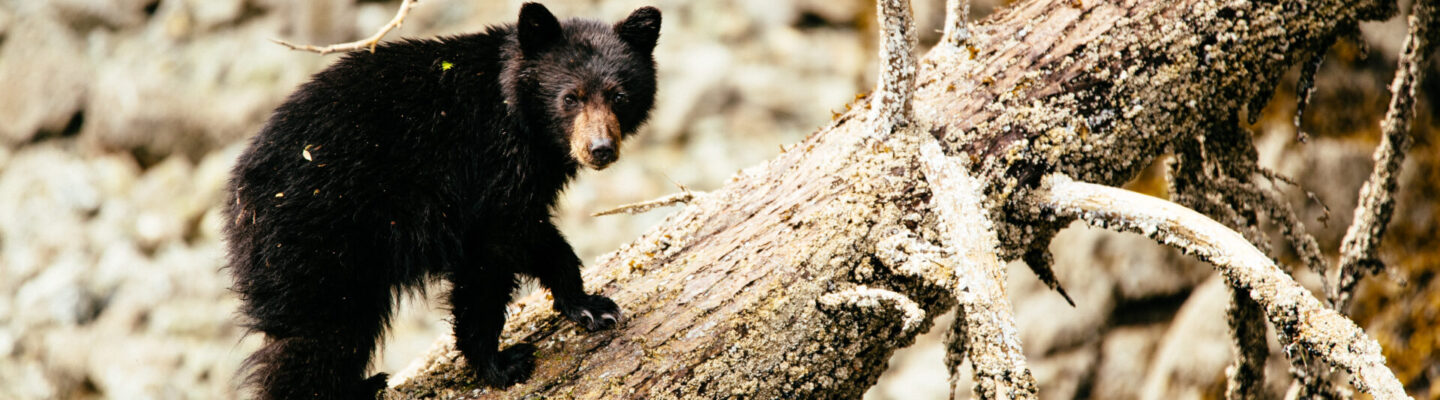
- Black bears (Ursus americanus) – the most widespread, found in forests, mountains, and near human occupied areas. Colouring ranges from black to brown, cinnamon, or blonde. Black bears are involved in the majority of human/wildlife conflicts in BC.
- Spirit/Kermode bear (Ursus americanus kermodei) – Sub-species of black bear, both black and white individuals exist within the same population. Their colouration is caused by a recessive gene. Approximately 10% of the Kermode population are white (spirit bears). These bears are found within specific areas of the coast and are protected.
- Glacier bear (Ursus americanus emmonsii) – a rare blue-grey colour phase of the black bear, found in limited areas of the northwest part of the province. The genealogy of the glacier bear is still being researched.
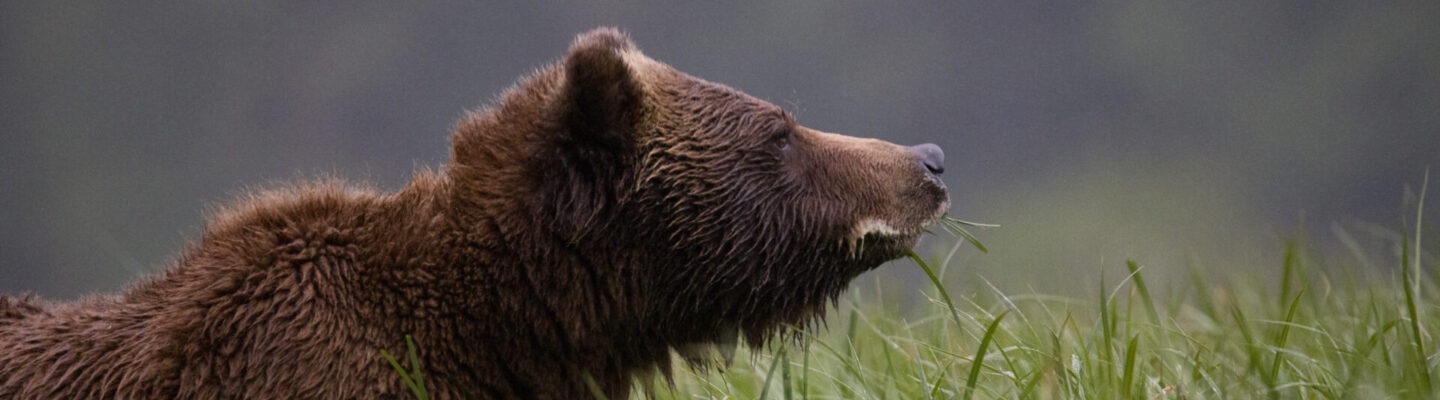
- Grizzly bears (Ursus arctos horribilis) – larger animals occupying remote wilderness areas, estuaries, river valleys, alpine terrain, and the Great Bear Rainforest.
Grizzly bears, Spirit bears, and Glacier bears are all protected from hunting in British Columbia, with the exception of First Nations’ rights to harvest for food, social, or ceremonial purposes.
How do I tell a black bear from a grizzly?
Colour alone is unreliable; black bears can be a variety of colours, including black, cinnamon, brown, blonde, white, and even blue. Use these physical features instead:
Black bear
- No shoulder hump
- Straight or slightly convex facial profile
- Pointed, taller ears
- Longer back legs, often resulting in the rump being higher than the shoulders
- Short claws; front toes more separated in tracks
Grizzly bear
- Prominent muscular shoulder hump
- Dished facial profile
- Small, rounded ears
- Long front claws; front toes closer together in tracks
How capable is a bear's sense of smell?
Bears have an extraordinary sense of smell that’s roughly 2,000 times stronger than a human’s. This allows them to detect food sources from great distances, including garbage, compost, pet food, cooking residue, empty packaging, toiletries, and clothing with food odour. Bears do not distinguish natural from human-provided food sources; if something smells like food, they will investigate it. They are typically impartial to consumption as well and will eat anything that smells like or contains food, including plastics.
When are bears most active?
Bears are typically active from spring through fall, with activity peaking during hyperphagia, an intense pre-denning feeding period that generally occurs between September and November, depending on your geographic location. During this time, a bear will consume approximately 20,000 calories per day, that’s equivalent to roughly 70 cheeseburgers!
Bears can be encountered at any time of day; however, larger males are often more active during evening hours. Bears seen during daylight are frequently females with cubs or sub-adult bears, which may be adjusting their activity patterns to reduce the likelihood of encountering a dominant male.
While bears are not strictly territorial, they operate within a social structure influenced by dominance hierarchy.
If non-natural food sources like garbage and other attractants remain available through winter, bears may delay den entry or, in some cases, forgo hibernation altogether.
What role do bears play in BC's ecosystems?
Bears serve as powerful indicator species because their presence signals a functioning ecosystem. As wide-ranging apex predators, they require large tracts of intact habitat, abundant prey, healthy salmon runs, and productive forests to survive, meaning a stable bear population reflects the health of an entire ecological community.
Beyond what they indicate, bears actively shape their ecosystems: distributing salmon-derived nutrients into forest soils, dispersing seeds, and creating disturbances that other species depend on.

Reading Bear Body Language
How can I tell if a bear is relaxed or stressed?
Understanding bear body language is important for minimizing your impact. A relaxed bear will naturally feed, move, or rest without interruption. The following behaviours may indicate a bear is stressed or unsure:
- Stops what it is doing to stare directly at your group multiple times or for an extended period
- Stiffens its posture or changes its orientation toward you
- Yawns, scratches, or sits abruptly (displacement behaviours)
- Paces or moves in and out of the bush
- Snaps its jaws subtly or flaps its lips
- Huffing, moaning or chuffing that is escalating
- Moves away or circles downwind to check you out
Important: If a bear displays these behaviours and does not resume normal activity, the viewing session should end. Respect the bear’s communication.
Bears will often tolerate the presence of people in order to access food. A bear that remains in an area does not necessarily mean it is comfortable, it may simply be prioritizing the need to feed.
Wildlife Photography Etiquette
How should I behave when photographing bears?
The growing popularity of wildlife photography has brought increased pressure on bears and their habitats. Ethical photography means paying attention to the bear’s behaviour and choosing respect for the bear over the shot. Your presence should never alter any animal’s natural behaviour.
- Never share the exact location of bears or dens online
- Never bait or feed bears
- Keep a respectful distance, use long lenses instead of approaching
- Leave dogs at home
- Avoid altering an animal’s natural behaviour
- Understand seasonal behaviours and stressors before heading out
- Prioritize the animal’s wellbeing over getting the perfect shot
Bear selfies are never a good idea!
If a bear appears nervous or stressed, you are too close. No photo is worth compromising an animal’s safety or disrupting its natural rhythm. The most powerful wildlife images are those taken with care and integrity.
Baiting or attempting to feed bears is unlawful under Section 33.1 of the Wildlife Act of British Columbia.
Bear Viewing Best Practices
What do bears need from us?
- Give bears lots of space, do not follow or crowd them
- Use binoculars and cameras from a distance
- Move slowly, stay quiet, and behave predictably; erratic behaviour can stress a bear
- Stay together as a group
What if I see a bear from my vehicle?
- If you want to get a look at the bear, stop your vehicle safely and off the road
- Do not leave your vehicle, please do not approach a bear on foot from a roadside stop
- Limit your viewing to 10–20 minutes
What if I see a bear while hiking?
If you are travelling on foot in bear country:
- Make noise to avoid surprising bears: yell out, sing, talk, or clap
- Keep all your senses alert; look well ahead and pay attention to bear sign
- Stay in the open as much as possible
- Keep dogs on leash at all times
- Stay together as a group
Tip: It is best to view bears in the company of a CBVA-trained bear viewing guide.
Food & Attractant Management
Why does food management matter so much?
One of the biggest threats to bears is access to unsecured non-natural food attractants. Once a bear learns that human provided foods; garbage, pet food, outdoor fridges or freezers, campsites, bird seed, livestock or a dirty barbecue provide an easy meal, it will likely return repeatedly. When bears become food-conditioned, relocation rarely works, most are ultimately destroyed for public safety risks. This isn’t the bear’s fault; it’s ours.
What counts as an attractant?
Bears investigate a wide range of scents beyond obvious food. Common attractants include:
- All food and beverages
- Garbage, recycling, and food packaging or wrappers
- Cooking equipment, BBQs, and camp stoves with residue
- Pet food and bird feeders
- Toiletries, sunscreen, lip balm, scented soap, and perfume
- Dirty dishes, cutlery, and cookware
- Empty cans and bottles with residual smell
- Clothing with food or grease odour
- Outdoor fridges, freezers and camping coolers
- Unsecured livestock or free-roaming and off leash domestic animals
How do I manage food while hiking?
- Keep food in your daypack and never leave it unattended on the trail.
- Eat at designated areas or open spots with good visibility, not deep in brush.
- Pack out all food waste, including fruit peels, cores, and nut shells.
- Use sealable bags or bear-resistant containers to minimize odours.
- Dispose of food scraps at designated waste stations only, please do not bury or scatter them.
How should I store food at a campsite overnight?
Keep all food and attractants out of your sleeping area and out of reach of bears. Three main options:
- Bear-resistant containers: Hard-sided certified containers. Store them at least 30 metres from your sleeping area.
- Bear hang: Suspend food at least 4 metres off the ground and 2 metres from the trunk. Test your system before the trip.
- Food lockers: Use metal food storage boxes where provided at BC provincial campgrounds, for all attractants, not just food – This is the best option!
Never leave coolers, trash bags, or food unattended, even for a minute. Leave your campsite cleaner than you found it. We do not recommend consuming food in your tent.
How should I manage attractants at home?
- Store garbage in a bear resistant container or in a garage or shed.
- Put out garbage only on the morning of pick-up, never the night before.
- Remove or secure bird feeders. If you must have them, please bring them in at night or when you’re not home.
- Pick ripe fruit promptly and collect fallen fruit from the ground.
- Clean and store BBQs after each use; empty the grease trap.
- Feed pets indoors and do not leave pet food outside.
- Secure compost in a bear-resistant composter; avoid adding meat or dairy. It’s best to freeze compost until pick up date if you plan to place it at the curbside for collection.
- Store pet and livestock feed in a bear-resistant location.
- Avoid the use of outdoor fridges or freezers
- Keep pets on leash and properly secure livestock.
Important: Under Section 33.1 of BC’s Wildlife Act, providing attractants to dangerous wildlife is prohibited. Violations can result in significant fines.
Is it safe to leave food in my vehicle?
No. Vehicles are not secure storage in bear country. Bears can smell food through a closed window and are effective at breaking in through door seals, windows, and soft tops. In many BC provincial and national parks, leaving food in a vehicle is a ticketable offence. Use a certified bear-resistant container or campsite food locker whenever one is available.
Bear Encounters
What should I do if I see a bear nearby?
- Stay calm. Do not run, running can trigger a chase response.
- Speak in a calm, deep voice so the bear can identify you as human.
- Make yourself look larger by raising your arms.
- Back away slowly without turning your back on the bear.
- Keep small children and pets close (ideally pets are on leash). Alert others in the area.
If the bear is near your home and you are in a secure location: stay inside and make loud noise, your voice, pots and pans, or an air horn. The bear should learn it is not welcome near human homes.
Alerting others is never a bad idea, though we should be prepared to coexist with bears at all times and not exclusively when our neighbours and friends alert us or when sightings are posted.
What if a bear approaches while I have food out?
Stay calm. Slowly pack up and seal all food, then back away without turning your back on the bear. Never throw food at a bear to distract it, this directly rewards the approach and reinforces food-conditioned behaviour, increasing the danger for the next person the bear encounters.
Deploy bear spray if the bear continues to approach. If no bear spray is available, leave the food and back away from the area. Please call the BC Conservation Officer Service to report this incident at 1-877-952-7277.
What should I do during a bear attack?
- Defensive attack (grizzly, likely protecting cubs or food): Play dead. Lie flat on your stomach, legs spread, hands laced behind your neck. Remain still and silent until the bear leaves and you are certain it is gone.
- Predatory attack (Likely Black Bear, stalking and persistent, leading to tactile contact): Target the nose and eyes. Do not play dead. In nearly all cases, fight back immediately. Black bear attacks are almost always predatory.
Bear Spray
Should I carry bear spray?
Yes. We strongly recommend bear spray for anyone recreating, visiting or living in BC bear habitat. Research consistently shows it is the most effective deterrent in a bear encounter, more effective than firearms in most close-range scenarios. Carry it in a hip holster, accessible within two seconds.
Important: Bear spray is a last-resort deterrent, it does not replace proper food management. Be proactive instead of reactive! Keeping bears away from your camp and food is always preferable to a close-range confrontation.
How do I carry and use bear spray correctly?
- Choose a canister with a minimum 225 g volume and capsaicin concentration of at least 1%.
- Carry it in an accessible holster on your hip or chest, not in your pack.
- Check the safety clip and expiry date before each trip.
- To deploy: remove the safety clip, aim slightly downward toward the charging bear, and spray in a sweeping motion when the bear is within 10 metres. Create a cloud barrier between you and the bear.
- Bear spray is not a repellent, never spray it on yourself, your gear, or your tent.
Tip: Before your trip, practice drawing and deploying the canister so the motion is automatic, we recommend using an inert canister for this activity as it does not contain capsaicin. A bear encounter is not the moment to figure out the safety clip.
All cans of bear spray typically come with a zap strap


When should I report a bear encounter?
When should I report a bear encounter?
- A bear entered a campsite, vehicle, or building.
- A bear showed agitated or confrontational behaviour toward a person or pet.
- A bear appeared injured, sick, or in distress.
- A bear was feeding on an attractant in a residential or recreational area.
- You found a dead bear under suspicious circumstances
It’s good practice to report all conflicts, encounters or sightings in highly populated areas. Early reporting enables community education and can positively influence both public and bear behaviour.
What if I find an injured bear?
Only cubs of the year (COY) are eligible for assistance from a wildlife rehabilitation facility. There are only three facilities in the province with permitting to care for bears.
There are no facilities or veterinary services that can be provided to adult bears. Bears are resilient and can sometimes recover from injuries, but sometimes the humane thing to do is end their suffering.
Report injured bears to the BC Conservation Officer Service.
Please note, only individuals listed under provincial permitting have the authority to rescue and transport bear cubs.
For more information on British Columbia’s black bear orphaned cub policy including wait periods and responses, please visit: Orphaned Black Bear Cubs
*Please note the response for grizzly bear cubs may vary
What will happen if I report a bear conflict?
Responses to conflict are dependent on the specific circumstances of the situation. Conservation officers respond to calls made by the public, but not every call will warrant a response. Not every call results in the fatality of an animal. Reporting conflicts early provides more options for both the bear and the public.
Please remember that the RAPP line is part of a call centre that handles calls for multiple government branches and emergency services. Flooding the RAPP line with calls does not result in faster responses, nor does it create additional pressure or influence the outcome of conflicts.
Who do I contact?
BC Conservation Officer Service (RAPP): 1-877-952-7277 – available 24/7. Report conflicts, poachers, and polluters.
Provincial Wildlife Education Resources
WildSafeBC: wildsafebc.com – Provincial wildlife education and resources, some communities have WildSafe coordinators. Visit their website for more information
Regional Wildlife Education Resources
- Wild Wise Society: wildwisesociety.org
- North Shore Black Bear Society: https://northshorebears.com/
- Northern Bear Awareness Society: https://www.northernbearawareness.com/
- Revelstoke Bear Aware: https://revelstokebearaware.org/
- Silver Star Bear Stewardship: https://www.silverstarbearstewardship.com/


Donate to the Commercial Bear Viewing Association
If you’d like to do more, consider donating money to the Commercial Bear Viewing Association. You can earmark your donation specifically for research or conservation and you can be assured that we will make your donation make a difference for bears in British Columbia.